Every patio blind we make has to go up and come down, and how it does that shapes every day you own it. Three mechanisms cover the range: a rope-and-pulley system, a gear-and-crank handle, and a motor with a remote. None of them is “best”. Each is right for a particular blind, a particular patio and a particular way of living — and the wrong one is a blind you stop using.
Here is what each one is, what it costs from, and how to choose.
Key takeaways
- Rope and pulley is the best-value system in our range: stainless-steel yacht pulleys and heavy-duty UV-stabilised rope, the blind raised by hand and tied off. Simple, hard-wearing, right for blinds you set for the season.
- Gear and crank is the standard on our side-track blinds and blinds with clear PVC windows: a geared winder and a handle, nothing to power. A 3 m × 2.7 m blind in Docril with PVC windows, or in Sheerweave, starts at R6,900.
- Motorised turns the mechanism into a button — remote, radio wall switch or hard-wired switch. Motorisation with programming adds from R5,400 to a blind; our full-track screens come motorised.
- The honest rule: the wider the blind, the higher it hangs, and the more often you raise it, the more a motor earns its price. A blind you drop for winter and leave does not need one.
01 · The mechanics
What actually happens when you raise a patio blind
A patio blind is a sheet of fabric — Docril acrylic, Sheerweave mesh, clear PVC or Ripstop — that has to be lifted clear of the opening and held there. Either it rolls up onto a tube at the top, or it is gathered up on ropes. Something has to do the lifting, and that “something” is the choice you’re making. Same fabric, same fittings; the mechanism decides who does the work: you, or a motor.
02 · Rope and pulley
The rope: the best-value classic

Our rope-and-pulley range is the best-value product we make, and the one many homeowners and restaurants choose for a patio that needs closing off completely. The blind runs on stainless-steel yacht pulleys with all-stainless fittings, raised and lowered on heavy-duty, UV-stabilised rope, and tied off at the height you want. Zipper and Velcro systems seal the edges. There is nothing mechanical inside, nothing to power, and nothing to service but rope you can see.
Where it fits: blinds you set for the season and leave — the weather side of a covered patio, a lapa, a braai area you close for winter. Where it doesn’t: a blind you want up and down every afternoon, or one you’d like a motor on later. A rope system is manual by nature.
Right for: set-and-forget enclosures, hard-wearing sites (that is what the stainless is for), and buyers who want the simplest thing that works at the lowest price. Rope-and-pulley blinds
03 · Gear and crank
The handle: reliable, nothing to power

Our side-track blinds and blinds with clear PVC windows come on a gear-and-crank mechanism as standard: a geared winder on the roller tube, turned by a detachable handle. You wind, it rises; wind the other way, it drops. Nothing to charge, nothing to programme, no wiring, and not much that can fail. Because the blind runs in side tracks or channels rather than on ropes, it holds taut against the wind and sits neatly at any height.
The trade-off is effort and reach. On a modest blind it is a few turns of the handle. On a wide blind, or one hung high, it is more work every time — and the blinds that stay down all winter are usually the ones that are a chore to raise.
Right for: blinds you adjust now and then, patios where you want a clean tracked look without the motor cost, and anyone who wants the least to go wrong. From: a 3 m × 2.7 m blind in Docril with clear PVC windows, or in Sheerweave, starts at R6,900. Side-track blinds · Blinds with clear PVC windows · All patio blinds
04 · Motorised
The button: the blind you actually use
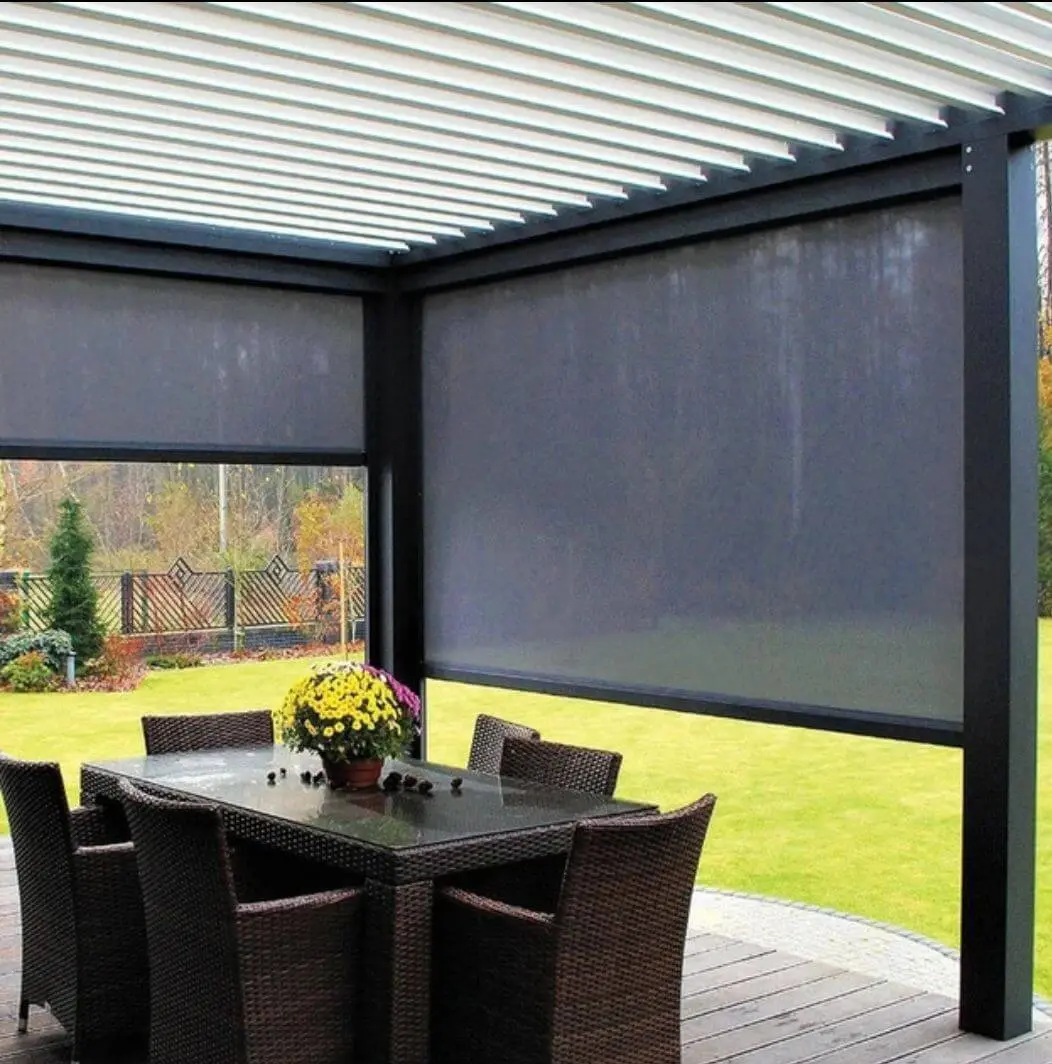
A motor inside the roller tube does the winding, and you press a button. The controls are a remote, a wall switch that talks to the motor by radio and runs on a battery so it needs no cabling, or a hard-wired switch. Our side-track blinds come manual or motorised; our full-track screens come motorised as standard — extend or retract them with the push of a button.
The case for it is not laziness. It’s use. A blind that rises in a few seconds gets raised — for the two-hour lunch, for the hour the wind drops — where the same blind on a crank stays down because it isn’t worth the winding. Over a season that is the difference between a patio you enclosed and a patio you use. And on a wide blind a motor is also the mechanism that treats the fabric gently: even tension, no wrenching, every time.
What it costs from: motorisation with programming adds from R5,400 to a patio blind. Set against the R6,900 blind above, that is a real decision — which is exactly why it should be made on how you’ll use the patio, not on the number alone.
Right for: wide blinds, blinds hung high, sets of several blinds you want to move together, patios you use most days, and anyone who has had a crank blind before and knows they stopped raising it. Full-track screens · Side-track blinds
05 · Side by side
The three, compared
| Rope and pulley | Gear and crank | Motorised | |
|---|---|---|---|
| On | Rope-and-pulley blinds (zipper and Velcro systems) | Side-track blinds; blinds with clear PVC windows | Side-track blinds; full-track screens |
| You do | Pull a rope, tie it off | Turn a handle | Press a button |
| Power | None | None | Mains to the motor; a battery in the radio wall switch |
| Best at | Blinds set for the season; full enclosure at the lowest price | Occasional use; a clean tracked look | Wide, high or daily-use blinds; several blinds together |
| Watch for | Manual by nature — cannot be motorised | Effort on wide or high blinds | Higher up-front cost |
| From | Quoted at the measure — the best-value system in the range | 3 × 2.7 m blind R6,900 | + R5,400 with programming |
All figures are from-prices; see the full price guide.
06 · Choosing
How to choose in one minute
Three questions:
- How wide and how high? A modest blind within reach — a crank is fine, and rope-and-pulley if you set it and leave it. Wide, high, or several together — motor.
- How often? Down for the season — rope-and-pulley. Now and then — crank. Most days — motor.
- Who raises it? If the honest answer is “whoever’s willing to fetch the handle”, it will stay down. A button gets pressed.
Whichever you lean towards, the measure is where it gets decided: Mitch will tell you on your patio, looking at your opening, which one you’ll actually use.
Questions people ask
Frequently asked questions
Which patio blind mechanism is cheapest?
Rope-and-pulley — it is the best-value system in our range. Gear-and-crank sits in the middle: a 3 m × 2.7 m blind starts at R6,900. Motorisation with programming adds from R5,400 to a blind.
Can rope-and-pulley blinds be motorised?
No — a rope system is manual by nature. If you think you will want a button later, choose a side-track blind on gear-and-crank or a motor from the start.
Does a motorised patio blind need wiring?
The motor does; the controls needn’t. A radio wall switch runs on a battery and needs no cabling, and the remote needs none. A hard-wired switch is wired.
Which mechanism suits which blind?
Rope-and-pulley on our rope-and-pulley range with zipper and Velcro systems. Gear-and-crank or a motor on side-track blinds and blinds with clear PVC windows. Our full-track screens are motorised.
Do you service all three?
Yes — ropes and pulleys, cranks and motors, on our blinds and on ones we didn’t make. See our recovers and repairs page.
Rope, crank or motor, we make it, fit it and service it — and Mitch will tell you at the measure which one you’ll actually use. The on-site measure and quote are free, and the price quoted is the price paid.